If you have heard Sankofa only in the context of corporate diversity training or a viral leadership quote, you have not really heard Sankofa. Sankofa and Parenting? The version of the word that survives in Ghana, West Africa is older, stranger, and more demanding than the version that travels.
What Sankofa Actually Means
Translators usually settle on something like: Sankofa is an Akan word and a symbol — most often a bird with its head turned backward, holding an egg in its beak. The egg is the future; the head turned backward is the past. Together they teach a simple, demanding idea: it is not wrong, nor shameful, to go back and fetch what you forgot. The future cannot be built on amnesia. It is a defensible translation. But translation is the surface. Sankofa carries underneath it a set of assumptions — about what a person is, what owes what to whom, and what success even means — that the English sentence cannot deliver.
Wisdom is like a baobab tree; no one individual can embrace it.Akan
The Question This Post Is About
Raising children with Sankofa in a culture that doesn't share its assumptions. The question is worth taking seriously, because Sankofa is one of those concepts that loses its shape when handled carelessly — and recovers it as soon as the reader is willing to slow down and listen.
Outside the workplace, Sankofa reads differently — and harder. In a household, it is not a leadership philosophy; it is a daily, sometimes irritating, set of obligations. The phone call you owe. The message you have not answered. The relative whose problem is now your problem because no one else is closer. Before changing a long-running practice, the team asks an elder of the practice what it was for. Sankofa does not let you opt out of these.
A Second Angle
Take the modern workplace as a test case. The dominant Western model treats the team as a coalition of individual contributors who happen to share a Slack channel — each evaluated alone, promoted alone, and let go alone. Sankofa starts somewhere different. It assumes that the unit of analysis is the team, that performance is co-produced, that to praise a single person without naming the people around them is a kind of category error. The implications are uncomfortable for managers trained in the Western model. Before changing a long-running practice, the team asks an elder of the practice what it was for.
Where the Concept Resists
There is also the question of authority. Who gets to speak for Sankofa? The traditions in which it lives are old, plural, sometimes in disagreement with each other. Anyone — including the writer of this essay — who claims a definitive reading is overreaching. The careful reader treats every restatement of Sankofa, including this one, as one voice among many.
What to Do With This
If you are new to Sankofa, the most useful place to start is not with a study or a course but with a question, asked of yourself, at the end of an ordinary day: who held me up today, and whom did I hold? Sit with the answer. Do not improve it yet. The concept will deepen on its own, repeated, over weeks. This is how Sankofa actually enters a life.
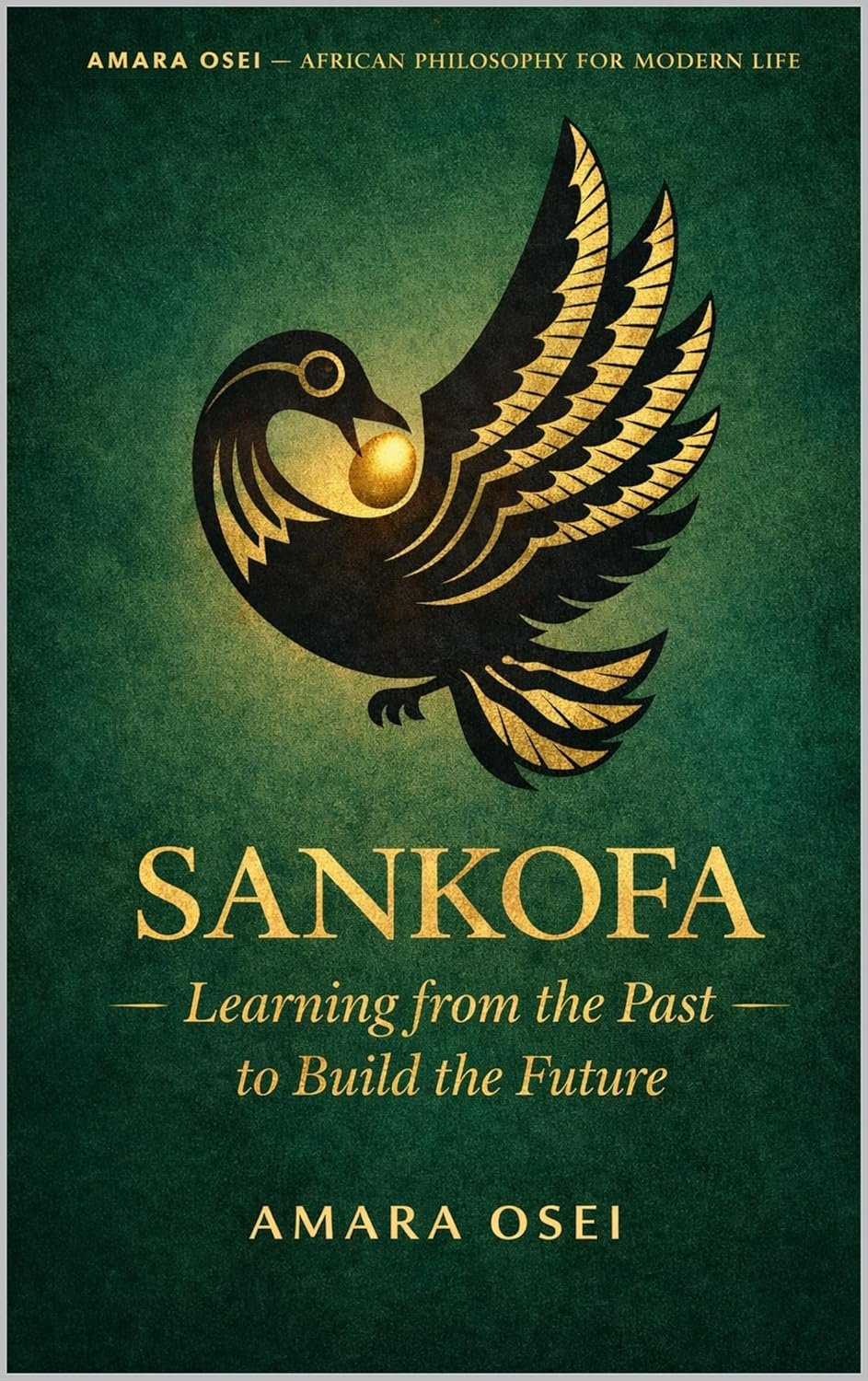
The full philosophy, as a book
How to use your history, your failures, and your traditions as fuel rather than baggage.
Read on Amazon