Of all the Wolof / Senegalese concepts that have crossed into English usage, Teranga has had perhaps the strangest journey. Teranga and Wabi-Sabi? The journey itself is part of the answer. To understand Teranga now, you have to understand both the original and the diasporic version, and the gap between them.
What Teranga Actually Means
Let me give the canonical definition first, then try to do a little better. Teranga is a Wolof word that does not translate cleanly. The closest English approximation is hospitality, but it is hospitality elevated to a defining cultural virtue. It is why Senegal calls itself 'the land of teranga.' It is the reflex to feed a stranger, to seat them, to ask after them. In the modern world it is also a strategy — for sales, leadership, customer experience, and any practice that depends on people choosing to come back. The canonical version is correct but tame. The full version of Teranga is less polite, more demanding, and more interesting. It does not flatter the reader who has just discovered it.
Hospitality is the first medicine.Senegalese
The Question This Post Is About
Two beauty-philosophies — one from Senegal, West Africa, one from Japan — with surprising agreements. The question is worth taking seriously, because Teranga is one of those concepts that loses its shape when handled carelessly — and recovers it as soon as the reader is willing to slow down and listen.
Take the modern workplace as a test case. The dominant Western model treats the team as a coalition of individual contributors who happen to share a Slack channel — each evaluated alone, promoted alone, and let go alone. Teranga starts somewhere different. It assumes that the unit of analysis is the team, that performance is co-produced, that to praise a single person without naming the people around them is a kind of category error. The implications are uncomfortable for managers trained in the Western model. First-day hires are walked to lunch, not handed a checklist.
A Second Angle
The comparison is not symmetric. Teranga did not develop in dialogue with the Western frameworks it now sits beside on a bookshelf. It developed inside Wolof life, answering questions that Wolof life kept posing. To ask whether Teranga is "better than" individualism, or stoicism, or productivity culture, is to ask the wrong question. The right question is narrower and more useful: what does Teranga see clearly that the framework I currently use does not? First-day hires are walked to lunch, not handed a checklist.
Where the Concept Resists
Teranga is sometimes presented as the answer to the diseases of Western individualism. It is not, exactly. It is a different answer to a different question. Pretending it is a drop-in replacement for the modern self-help bookshelf does Teranga a disservice — and the reader, too. The work of taking it seriously is harder than that.
What to Do With This
If you are new to Teranga, the most useful place to start is not with a study or a course but with a question, asked of yourself, at the end of an ordinary day: who held me up today, and whom did I hold? Sit with the answer. Do not improve it yet. The concept will deepen on its own, repeated, over weeks. This is how Teranga actually enters a life.
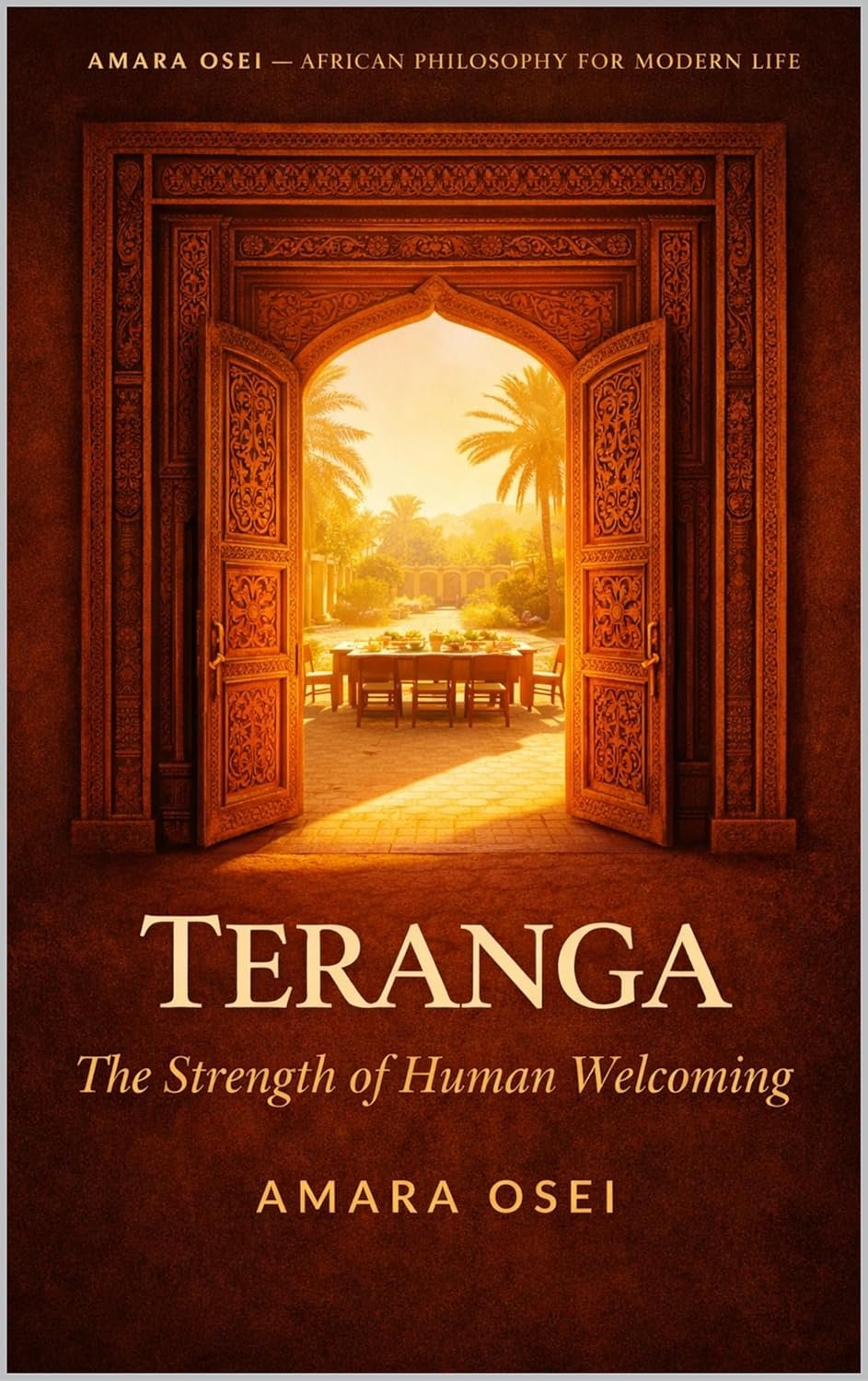
The full philosophy, as a book
The Senegalese philosophy of generosity as strategy — in business, sales, leadership, and life.
Read on Amazon